Who grills Korean BBQ, who actually pays, and the banchan, ssam and drink customs nobody explains, with real Seoul samgyeopsal prices.
- There's no fixed "youngest grills" rule anymore: plenty of restaurants send a server to do the cutting and grilling for you.
- Whoever invited you usually pays: offer once, then let it go, and cover the next round or dessert instead.
- Before you sit down: don't pour your own drink and don't grab the tongs before anyone else moves.
Most guides on Korean BBQ etiquette describe a strict, unmoving rulebook: the youngest always grills, the bill never gets split, there's exactly one correct way to eat a lettuce wrap. That's mostly outdated. Sit at a table in Gangnam or Samseong on any given night and the tongs go to whoever's closest to the grill, plenty of the newer restaurants send a server to do the cutting for you, and the person who started the group chat is the one reaching for the card at the end.
The etiquette hasn't disappeared, though. It's just quieter than the version that gets repeated online, and it still trips people up in exactly the moments a rulebook wouldn't warn them about.
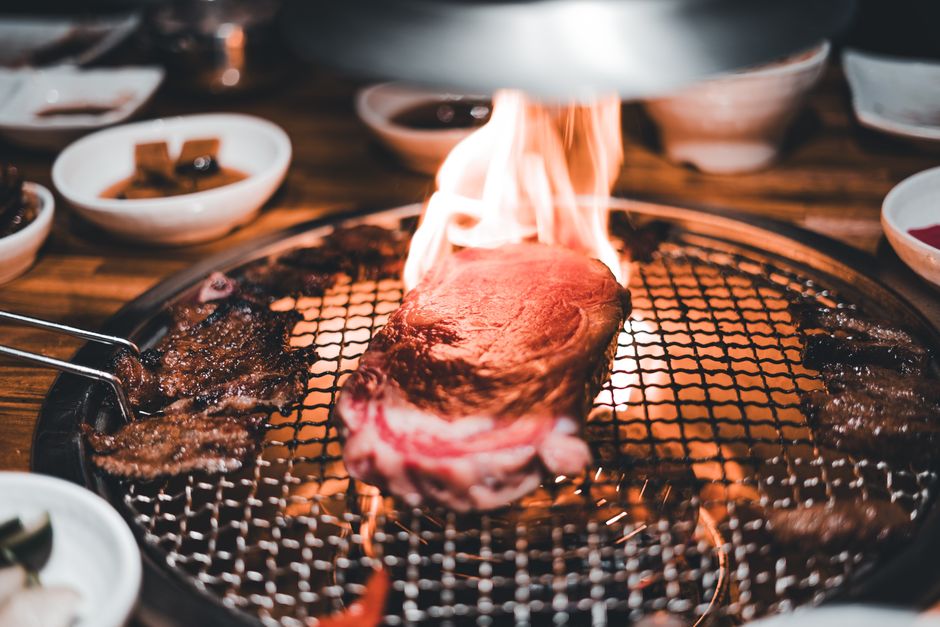
Koreans call the restaurant itself a gogijip (고깃집), literally a "meat house," and the format is the same almost everywhere: a grill built into the table, a rack of raw cuts, and a ring of small dishes that fills in around it.
What is a gogijip (고깃집)?
Literally a "meat house": a restaurant built around a tabletop grill, where the kitchen sends out raw cuts and diners cook them themselves, or a server does it table-side. Nearly every Korean neighborhood has at least one.
🔥 So, who actually grills the meat?
There's no single rule anymore, and increasingly, it isn't even a guest's job. The older version of the custom put the tongs in the hands of the youngest or lowest-ranked person at the table, since serving the group was considered part of that role. That still holds at plenty of tables, especially with an older crowd, and grabbing the tongs first as a junior guest can read as presumptuous. But a growing number of Korean BBQ restaurants now send a staff member, often called an 이모 (imo, "auntie") even when she isn't related to anyone at the table, to grill and cut the meat table-side rather than leaving it to the diners. Either way, expect scissors, not a knife, doing the cutting once the meat is cooked through.
What does 이모 (imo) mean at a restaurant?
Literally "aunt" on the mother's side, but at a restaurant it's the everyday way to call a server over. At many gogijip, the 이모 is also the one who grills and cuts the meat table-side.
A quick glance at the next table over usually tells you which kind of place you're in, so it's worth checking before you reach for anything.
💳 Who ends up paying the bill?
Usually, whoever suggested the meetup, and it's considered polite for that person to cover the whole bill rather than split it. "밥값은 대개 먼저 만나자고 제의한 사람이 내는 것이 통상적인 예의," meal costs conventionally fall to whoever proposed the meeting, is how a Korean-community news column put it.
The same piece notes that Koreans more often let one person cover everything than split evenly the way Western groups tend to. Between a senior and a junior colleague, the senior is expected to pay, on the logic that seniority comes with the obligation to treat. If you're a foreign guest, a local host may simply insist on the bill; the graceful move is to offer once, then pay for a different meal or a round of drinks another time.
Company dinners (회식) can sidestep the question entirely: one Korean bank's own staff blog, describing how it books its team's meat dinners, mentions putting the meal on a corporate card, which takes the "who pays" question off the table for everyone there.
| Setting | Who usually grills | Who usually pays |
|---|---|---|
| Friends the same age | Whoever's nearest the grill | Often split evenly, turn by turn |
| Work dinner (회식) | The most junior colleague, unless staff does it | The company, often a corporate card |
| A local host treating a guest | The host, or staff | The host (offer once, then let it go) |
These are tendencies, not fixed rules, and a company card quietly erases the question at most 회식. Checked 2026-09-25.
🥬 Banchan, ssam and the rest of the table
Two habits mark a first-timer faster than anything else: asking how much a banchan refill costs, and pouring your own drink. Side dishes (kimchi, bean sprouts, garlic, lettuce) refill for free at almost every gogijip; just say "반찬 더 주세요" (banchan deo juseyo, "more side dishes please") and more arrives, no extra line on the bill.

Wrapping the meat is its own small ritual. Take a lettuce or perilla leaf, add a piece of grilled meat, a dab of ssamjang (the thick, salty-sweet dipping paste), and whatever else is on the table (garlic, kimchi, a sliver of raw onion), then eat it in one bite. That's a ssam (쌈), and building one for someone else at the table, especially an elder or a guest, is a small, genuine gesture of hospitality.
What is a ssam (쌈)?
A wrap: a leaf of lettuce or perilla, folded around a piece of grilled meat and whatever sauce or side dish you like, eaten in one bite. There's no fixed recipe. Building your own is the point.

Drinks follow their own small rules. Pour for the people around you rather than for yourself, and they'll return the favor. If someone senior pours for you, take the glass with both hands, and if it's soju, turn slightly away from them as you drink.
None of it comes with a tip. Korea doesn't tip at restaurants, gogijip included, and offering one tends to confuse the staff more than it flatters them. When the meat's gone, most places finish with fried rice made from the leftover fat and juices on the same grill; order it, since it's usually the best five minutes of the meal.
- If you have one more question Ask your host, or the server, whether the restaurant does table-side grilling before you sit down; it changes who's expected to pick up the tongs.
- What locals argue about Whether splitting a bill evenly among people the same age is just practical or a little cold; older diners tend to prefer one person covering the whole thing, calling it the warmer option.
- Watch for More Seoul gogijip adding table-side grilling as a standard service each year, which quietly shrinks the whole etiquette question for everyone at the table.
- What if I'm the oldest person at the table?
- Then everyone's quietly waiting for you. By Korean custom the eldest diner eats first, so start promptly rather than insisting others go ahead. Hosting four? Budget 4 × ₩17,745 = ₩70,980 (roughly $53) before soju or beer.
- Can I go for Korean BBQ on my own?
- Yes, though you'll often pay for two. Most places insist on a minimum of 2 servings even for a single diner, so at the Seoul average that's 2 × ₩17,745 = ₩35,490 (roughly $26.50). Look for a 1인분 가능 sign, meaning one portion is available, to eat alone for less.
None of this is really about getting a rule right. Show real interest in the wrap, the drink-pouring, the free banchan refills, and most hosts will forgive an out-of-order tongs grab without a second thought. If you're unsure at the table, follow whoever's oldest or whoever invited you, and let them lead.
Prices and hours were checked on 2026-09-25; they change, so double-check before you go.
Sources
- [press] The Seoul Shinmun, samgyeopsal restaurant price data for Seoul, H1 2026 (2026-08-25)
- [press] Etoday, USD/KRW exchange rate (2026-09-07)
- [other] KoreaPeek, Korean BBQ Etiquette Guide (tongs/seniority, banchan refills, drink pouring, tipping)
- [other] Weverse Magazine, "[NoW] 한국인의 고기 굽기" (staff table-side grilling and cutting)
- [other] WikiTree, five things foreigners find surprising about Korean BBQ culture (scissors, ssam, fried-rice finish)
- [other] KOCA News, column on who pays for a meal in Korea
- [other] K bank official blog, on corporate-card payment at Korean office meat dinners

A Korean living in Seoul who checks the timetable before trusting the brochure.
Drafted and researched with AI help, checked against the sources, then read and approved by me before it goes up.


No comments:
Post a Comment